Our Story
The Consumer Goods Council of South Africa (CGCSA) is an industry association representing over 9 000 member companies in the Consumer Goods, Retail and Services (FMCG) sector, which is one of the largest employers in South Africa providing employment to more than 1.2 million people and contributes up to 20% of the national GDP.
The Food Safety & Sustainability Initiative (FSSI) is a division of the CGCSA, which provides thought leadership, guidance and technical support on regulatory aspects of the FMCG value chain (including retail and technical services) with focus on food safety, quality, nutrition, health and wellness and related matters.
The South African Food Loss and Waste Initiative (SA FLWI) was launched on the 29th of September 2020, as an outcome of a series of dialogues that involved over 500 stakeholders in the South African food value chain. The aim of the Initiative is to prevent and reduce food loss and waste in South Africa by half by 2030.
The CGCSA as the convener serves as the Secretariat for the SA FLWI, supported by the Department of Trade, Industry and Competition and the Department of Forestry, Fisheries and the Environment. The initiative remains free for companies to join as Signatories thanks to various funding and goodwill.
International climate action NGO Waste and Resources Action Programme (WRAP) has received catalytic funding from Rainier Climate, supporting the essential work of WRAP and partners in tackling food loss and waste through existing Voluntary Agreements in Australia, Indonesia, Mexico, South Africa and to create a new food waste voluntary agreement in Brazil.
The funding covers ongoing work with money allocated to each nation to increase the systemic Target-Measure-Act approach to reduce food waste across supply chains and in the home, which globally are responsible for around 8-10% of all greenhouse gas emissions.



Global Food Pact Network

Our mission is ambitious yet essential: to halve South Africa's food loss and waste by 2030. We focus first on prevention, then reduction, and then on encouraging the redistribution of nutritious surplus to those in need. We are transitioning South Africa towards a circular economy where food is valued, not wasted. From industrial supply chains to local households, we are scaling our impact to ensure a sustainable, food-secure future for all.
South African Food Loss and Waste Utilisation Hierarchy
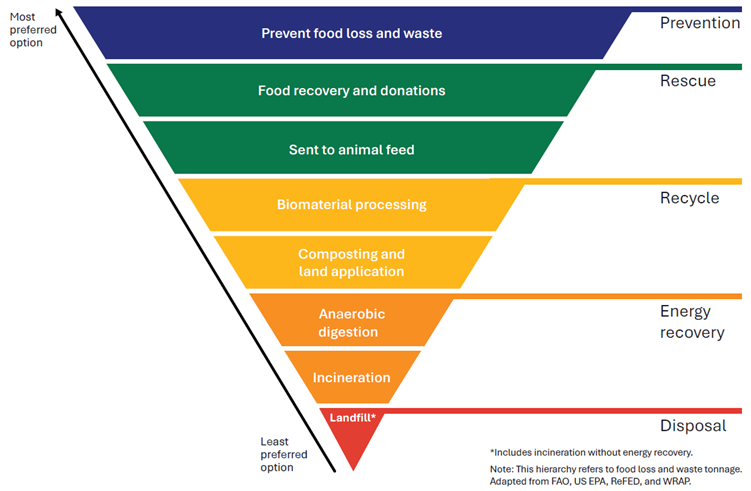
The South African Food Loss and Waste Initiative is working across the entire food supply chain, from primary producers right through to consumers.
There are two types of signatories that form part of the SA FLWI: core and associate signatories. Core signatories are entities that handle food, including agriculture and fishing, processors, manufacturers, retail and food service. Associate signatories are entities that can assist core signatories prevent or reduce FLW in their operations.
We collaborate closely with our core signatories, helping them to measure and report their food loss and waste and take action to prevent and reduce it, stay informed about best practices, and work collaboratively with others in the food value chain to reach Sustainable Development Goal 12.3.
Beyond the direct supply chain, we also partner with a wide range of associate signatories, including government, solution and service providers, research institutions, and vital food rescue organisations, among others, to assist core signatories prevent and reduce food loss and waste in South Africa.

Core signatory growth and representation
- The SA FLWI signatory base has grown from 16 in 2020 to 135 in 2025. The growth and diversity of signatories indicates that the SA FLWI is seen as an initiative that is valuable to a broad range of stakeholders in the South African food value chain.
- A 2025 analysis of the representation of the 2024 core signatory 1 base, which was conducted by the Bureau for Food and Agricultural Policy (BFAP), has shown that our signatories represent approximately 44% of the formal food value chain in South Africa. All the main formal food retailers are represented. Approximately 50% of the formal food processing and manufacturing sector and 54% of the main restaurant/QSR sector are represented. There is currently low representation in the agriculture and fishing and food service sectors. This analysis is being used to inform a targeted core signatory recruitment strategy in 2025.
- Social, environmental and financial business case development is being contracted to help support retention and recruitment of signatories.

Core signatory measurement, reporting and action
- A standardised and internationally harmonised food loss and waste measurement and reporting tool was developed in 2023, and core signatories are measuring the FLW in their businesses. South Africa is the first country to translate this reporting tool into a secure online reporting platform that allows core signatories to report and track their data over time.
- Core signatories 1 have been using the 'target-measure-act' approach to develop internal action plans to prevent and reduce waste in line with the food utilisation hierarchy.
- Data collected from 2021 to 2023 has been analysed by the Council for Scientific and Industrial Research to help inform a baseline for the SA FLWI in 2025. Social and environmental conversion factors development is being contracted to convert this data into social and environmental metrics.
- Research has been undertaken to identify two impact interventions to prevent and reduce FLW at scale in South Africa in 2025/2026.
Citizen campaigns
- The SA FLWI launched its first ever household food waste campaign, End Food Waste ZA, in 2025.
- Acampaign landing page and social media channels (Facebook and Instagram) were launched at beginning of August 2025.
- Research was conducted to gather consumer insights from South African consumers to inform citizen behaviour change campaigns. The first one is planned for 2026.

Guidelines & standards
- Core and associate signatories have worked together to develop a Food Donations Best Practice Guideline to help facilitate the donation of surplus food that is fit for human consumption to people in need. These guidelines were first published in 2022, were updated in 2023 and in 2025.
- These have been used to draft a national Food Donation and Redistribution Best Practice Standard through the South African Bureau of Standards, which will help support food donations in South Africa.
- A SA FLWI Animal Feed Working Group has been established to develop Guidelines to support the safe and effective use of food by-product for animal feed.

Policy & legislation
- Advocacy to address policy gaps to prevent and reduce food loss and waste is a key focus area for the SA FLWI.
- The National Strategy for Reducing Food Losses and Waste was published on the 29th of August 2025 and this strategy references and states the importance of the SA FLWI in reducing food loss and waste in South Africa.
- A SA FLWI Animal Feed Working Group has been established to develop Guidelines to support the safe and effective use of food by-product for animal feed.
The Advisory Committee ensures that there is effective support and guidance to enable the Initiative's mission to substantially prevent and reduce food loss and waste in South Africa. It is designed to represent the signatories of the Initiative and members of the committee are required to represent the sector in which they operate. The committee members provide the CGCSA with strategic direction and advice to ensure that the Initiative aligns with its mission and objectives, and remains objective in its focus and prioritisation of activities. The committee members offer expertise and insights based on their professional backgrounds and experience to help address the challenge of food loss and waste.
They also act as liaisons between the Initiative and various stakeholders across the value chain, including government , NGOs, research institutions, industry partners and civil society. The committee members provide oversight and accountability by monitoring the progress of the Initiative and ensuring that it is accountable and stays on track to meet its goals. The committee also assists in mobilising resources and funding needed to sustain the Initiative. The committee ensures that the Initiative adheres to ethical governance, standards and legal requirements. The committee meets quarterly and committee members serve for a period of 2 years.
Meet Our Advisory Committee